
Performance Reviews

This article is sponsored by Air France.
www.airfrance.com/us
Not Found
The requested URL was not found on this server.
Additionally, a 404 Not Found error was encountered while trying to use an ErrorDocument to handle the request.
More Search Options

Spa Ja
300 W 56th St
New York, NY 10019
212 245-7566
www.spaja.com
Tell them you saw them on ExploreDance.com for a 20% first visit discount!
spa body wraps
facials hydro-therapy
retail noninvasive facelift
tanning Brazilian manicure/pedicure
waxing laser hair removal - painless
massage noninvasive cellulite treatment

Click here to purchase Danskin New York City Ballet Dancewear collection. Enjoy free shipping with a purchase of $75 or more.
LimŪn Dance Company
JosČ LimŪn and Doris Humphrey, Founders
Carla Maxwell, Artistic Director
Donald McKayle, Artistic Mentor
Nina Watt and Roxane D'OrlČans Juste, Artistic Associates
Mark W. Jones, Executive Director
Publicity: Audrey Ross, audreyrosspub@aol.com
Presented at the Joyce Theater
www.joyce.org
May 2, 2003
Review by Dr. Roberta E. Zlokower
Doris Humphrey, a founder of American modern dance, performed for the Humphrey-Weidman Company between 1928 and 1944. JosČ LimŪn was a performer with this Company, and, eventually, Ms. Humphrey became his Artistic Director in 1946 and created new works for him, as well. Carla Maxwell joined the LimŪn Dance Company in 1965 and was soon a Principal dancer and then Artistic Director. Ms. Maxwell danced many major roles with the Company and teaches internationally. The LimŪn Dance Company is now in its 56th year and is committed to balancing classic modern dance works with contemporary commissioned works. Mr. LimŪn is known for dramatic choreography and masculine dancing. (Company Notes).
Invention (1949): Choreography by Doris Humphrey, Music by Norman Lloyd, Staging and Direction by Betty Jones, Rehearsal Direction by Nina Watt, Costume Design by Pauline Lawrence, Recreated by Marion Williams, Lighting Design by Ted Sullivan, Performed by Jonathan Riedel, Roxane D'OrlČans Juste, and Ryoko Kudo. To in solos and duos, these three amazing dancers softly leaped and soulfully appeared to nurture each other with touch and visual imagery, to the wonderful piano score by Mr. Lloyd. There were aerial configurations and dances that appeared to be mirror-like dancing, with shifts in mood and rhythm. Ms. Humphrey, the genius that she was, created a design that evoked the full compliment of human emotions.
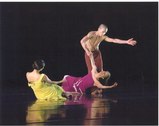
Members of the LimŪn Dance Company in Doris Humphrey's INVENTION
Photo courtesy of Lee Talner
Etude (2002): Choreography by Carla Maxwell, Music by Franz Schubert and Gretchen am Spinnrade, Costume Design by Katherine McDowell, Lighting Design by Ted Sullivan, Performed Solo by Kristen Foote. In a flowing pattern, danced to a lieder by Schubert, Ms. Foote, in an exquisite burgundy dress, used muscularity and melancholia as her motifs, and she exuded passion and power.
Transfiguration (1976): Choreography by Susanne Linke, Music by Franz Schubert, Costume Design by Susanne Linke, Lighting Design by Wilfried Kreisiment, executed by Ted Sullivan, Performed by Roxane D'OrlČans Juste. This was a dance of angst and despair, a fixed visual image, beginning and ending in darkness and silence. I am not familiar with Ms. Linke's choreography, and this was a brilliant work. Ms. D'OrlČans Juste's writhing and withering on the stage floor was heart-rending.
The Unsightful Nanny (2002): Choreography by Jonathan Riedel, Music by Camille Saint-SaĪns, Costume and Prop Design by Jessica Rothman, Scenic Design by Adele Riedel, Lighting Design by Ted Sullivan, Performed by the Company. This campy graveyard scene, a pantomime with an umbrella, was a perfect compliment to the seriousness and tenderness of the other pieces. The umbrella was actually an effective prop, as it was used for many imaginary purposes, such as a sword and a baby. It was a weapon and a gift, handed back and forth by the dancers, who fought and flirted, worried and tattletaled. Jonathan Riedel was both choreographer and lead dancer, playing the Nanny. This could have been a playground scene gone eery, or an old, silent film, plus a score by Saint-SaĪns.
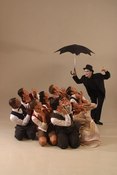
Members of the LimŪn Dance Company in Jonathan Riedel's THE UNSIGHTFUL NANNY
Photo courtesy of Beatriz Schiller
Psalm (1967): Choreography by JosČ LimŪn, Re-Staging and Direction by Carla Maxwell, Music by John Magnussen, Costume Design by Marion Williams, Lighting Design by Steve Woods, Performed by Jonathan Riedel, Roxane D'OrlČans Juste, Kristen Foote, and the Company. This piece is based on the tale of 36 Just Men, from ancient Jewish tradition. All the grief of the world is supposed to be poured into the hearts of these men, and if one is missing, mankind would perish. (Company Notes). This is a very percussive piece. I am not familiar with Magnussen's music, and it was truly potent. The motion and sound were reminiscent of Stravinsky's score for Les Noces, a Nijinska Ballet. The simple, gray costumes, almost unisex, except for the long skirt or pants to delineate gender, were reminiscent of a dance I had seen to celebrate the Chinese Military. The music and the Church Latin lyrics gave this piece a Judeo-Christian feeling.
This was an abstract and very severe work, with an abstract theme, dissonant music, and angular choreography. I thought I heard atonal chimes and a harmonic piano. Sometimes, the dancers moved in silence, a signature LimŪn motif. The final Hallelujah Chorus was very moving. Kudos to Jose LimŪn, who, although gone since 1972, lives on through the amazing legacy of his influence on the LimŪn Dance Company.

Members of the LimŪn Dance Company in JosČ LimŪn's PSALM Re-staged by Carla Maxwell
Photo courtesy of Beatriz Schiller

