
Performance Reviews

Not Found
The requested URL was not found on this server.
Additionally, a 404 Not Found error was encountered while trying to use an ErrorDocument to handle the request.
More Search Options
Spa Ja
300 W 56th St
New York, NY 10019
212 245-7566
www.spaja.com
Tell them you saw them on ExploreDance.com for a 20% first visit discount!
spa body wraps
facials hydro-therapy
retail noninvasive facelift
tanning Brazilian manicure/pedicure
waxing laser hair removal - painless
massage noninvasive cellulite treatment
Chicago Human Rhythm Project 15th Anniversary
www.chicagotap.org
Lane Alexander, Founder/Artistic Director
Richard G. Weinberg, Honorary Founder
Jill Chukerman, Public Relations
Lead Title Sponsor
Sara Lee Foundation
Global Rhythms
Harris Theater for Music and Dance
www.harristheaterchicago.org
Millennium Park
205 E. Randolph Drive
Chicago, Illinois 60601
312.332.7777
Susan Weinrebe
December 29, 2005
THE STRiPES
North American Premiere Performance
Company Director: HIDEBOH
Costume Design: Space Craft Produce Inc.
Performers: Hideyuki Higuchi (aka HIDEBOH), Hisao Ogatsu (aka RONx?), Yuji Uragami (aka SUJI), Noriyasu Yoshizaki (aka NORIYASU)
Funk-a-Step
OPENING THE STRIPES
Opening the Stripes
Composer: Shibuichi Abe
STEKISTEKKI (CRANKING CANE)
BURELIAS
HANA (FLOWERS)
Hana
Composer: Okinawa folk ballad arranged by Shibuichi
A CAPPELLA
HIDEBOH SOLO
ASIA
FESTIVO (FROM ZATOICHI)
Festivo
Composer: Hideyuki Higuchi, Shibuichi Abe, Keiichi Suzuki
Music performed by NORIYASU (percussion)
Choreographer: HIDEBOH
Just like the lower case letter smack in the middle of capitals, the Tokyo-based group known as STRiPES, makes you do a double take watching them perform.
The male tappers are dressed in persimmon red shirts and similar black suits reminiscent of lounge lizarding activity. Like a zipper up the back of one jacket, the orange hair dye job of another dancer, or frizzy "fro" and cap of the third, and shaved head of another, these guys are letting us know they're individuals and they're edgy.
Math was never my forte, so I can't do the figures here, but the phrase "exponential multiples" seems right to describe the numbers when STRiPES started to tap. During the nine pieces of their presentation, they grouped and regrouped themselves in variations their number, four, allowed, and in each dance, the swiftness of their tapping defied count.
Sometimes their rhythms slowed to near shuffles then gathered power until the metal of their cleats on the wooden sounding stage blurred each strike into one percussive beat. Yeah, they played with us, teasing and laughing as they worked, grins or nonchalant throw-it-away expressions belying the sweat equity they were investing.
Just like jazz performers riffing on a theme, one would step the pattern and another of the group would echo and embellish on it. They'd stand back and appreciate the groove one of their mates was working, then jump in to take over for a while.
Drumming on what looked like a large metal can, called up a primal thrill (as drumming nearly always does) in an early number. Like their feet, those drumming hands blurred until movement and sound became one.
They made it look like they were having fun, grinning, loose and easy, delighted to be there, and why not? This was their maiden appearance on a North American stage. I wish the theater had been more filled, but still, the respectable holiday-weekend crowd encouraged them all the way, and I think STRiPES responded to the energy.
One number in particular called to the rhythm in all of us. Looking a bit like mice in the nursery rhyme, the four dancers tapped in militarily timed precision while using canes for additional punctuation. The thrill of the sound, reverberation in the core of my body, and the visual aspect of their speed nearly airplaned me out of my seat.
And that's what this group calls to mind as I sum up their performance.
Rhythm. Precision. Speed. Rhythm, precision, speed. Rhythm, precision, speed. Rhythm,precision,speed,rhythmprecisionspeed. STRiPES!
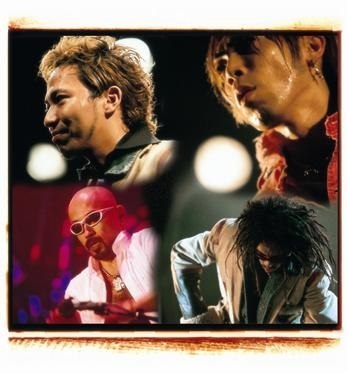
Chicago Human Rhythm Project - STRiPES
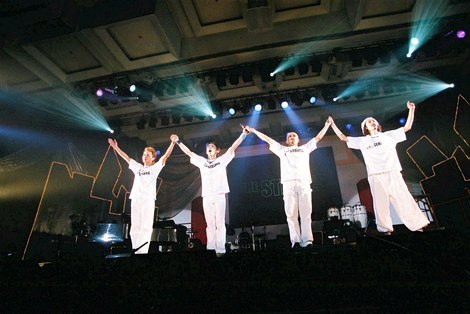
Chicago Human Rhythm Project - STRiPES
Vat· Tap
Bagaceira, the Orisha's Dance
Director, Choreography and Story, Music Director, Production Manager, Sound Designer, Choreographer, Fund Collecting: ValÈria Pinheiro
Writer: Orikis (a kind of mantra of the Orishas)
Original Music: Paulo JosÈ, Moacir BD, Edmar C’ndido, ValÈria Pinheiro
Executive Producer: Thais Andrade
Assistant Producer: SÌlvia Silton
General Manager: Thais Andrade, ValÈria Pinheiro
Stage Manager: AndrÈ Scarllazzari
Visual Arts: Paulo Amoreira
Costume Designer: Ruth Arag“o
Lighting Designer: Walter FaÁanha
Assistant Costume: Gil Braga
Vocal Instructor: Edmar C’ndido
Photographer: Paulo Amoreira
Media Relations: Thais Andrade, ValÈria Pinheiro
Video Producers: Leco/ ValÈria Pinheiro
Choreography Instructor (Air): Acleilton, ValÈria Pinheiro
Project: Thais Andrade, ValÈria Pinheiro
Cia. Vat·: Edmar C’ndido, Gerlane Pereira, Heber Stalin, Liliana Ara™jo, Laya Lopes, Thiago Cavalcante, Paulo JosÈ, Wellington CalaÁa, ValÈria Pinheiro
Musicians: Marcello Santos, Moacir BedÍ, F·bio Amaral, Klaus Senna
Rehearsal Instructors: Janahina Santos, Paulo JosÈ
Administrator: SÌlvia Silton
Set Producer and Designer: Marcos Alexandre
Rehearsal Place: Teatro da Boca Rica
One of the strangest and most unique dance performaces I've ever seen was staged by Vat· Tap in their multi-referencing work, Bagaceira, the Orisha's Dance. According to program notes, this is the second piece in a trilogy, which, in this part, relates to the body in various religious forms of worship including anima and Santeria.
ValÈria Pinheiro, the apparent lifeblood of the group, stated they believe this piece, "...is the bridge between Brazil and mother Africa, and we think that in dancing this musical we are honoring our ancestors."
With that said, the frameworks of three immense conga-like drums pillared the back right, center, and left sides of the stage. They looked like structures that could be ignited in some later bonfire. The struts of the frames glowed as if already molten or imbued with heavenly light, making the drums a presence as much as a backdrop.
Atop the left drum sat a woman swathed in a white turban and yards of gauzy fabric looking like a supplicant, pilgrim, or acolyte. She accompanied the dancers' movements with her own rhythmic swaying and undulating arms.
Between the drums hung weighty and pendulous chrysalis forms. To the right and left of the drums, near the wings, musicians stood unobtrusively with instruments and played throughout the production, while the leader stood at the center and drummed with two other drummers flanking her, elevated on platforms attached to the large drums.
Dancers were clad in gender-blending garments and tap shoes. The men wore puffy white pantaloons that resembled skirts and the two women were barelegged in boy shorts. They wore bras or variations of criss-crossed fabric tape like undergarment lacing in the Jean-Paul Gaultier corset dress style.
The twin cocoons opened to reveal dancers suspended within them. While they used the entwining strands of the hammocky cocoons to wend their way downward, the rest of the troupe crawled across the stage in imitation of animal life forms, also emerging onto the surface of the earth. Using articulated movements originating from their shoulders and swiveling their arms laterally, they resembled lizards slowly proceeding on their way.
Intermittently dancers would roll across the stage, break into cadres and tap in unison, emit cries or a string of words in Portuguese, climb the drum structures and dance atop them or climb into the structures and dance inside of them or climb the chrysalis webbing to perform aerial gymnastics.
An explanation of the mythology or theology beforehand would have made what was called, "...Brazilian tap opera," more coherent to an uninitiated audience. But lacking that, the drums as the central motif and accompaniment were a primal call to participate on the most visceral level.
Bagaceira, the Orisha's Dance, carried far greater mythic meaning than I was able to understand. Yet, this mysterious and emotion-filled performance well illustrated the purpose of the Chicago Human Rhythm Project. - to expose the audience to dance in the form common to all humans - rhythmic movement.
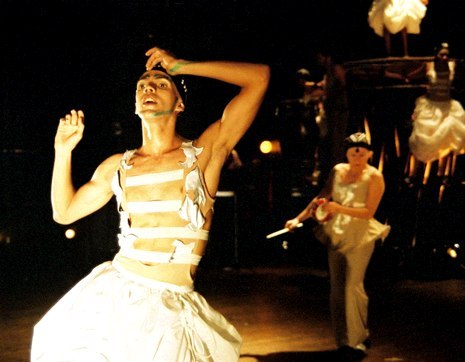
Chicago Human Rhythm Project - Vata Tap
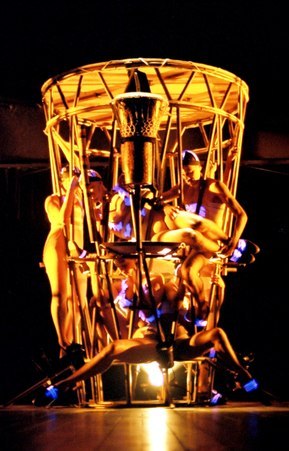
Chicago Human Rhythm Project - Vata Tap
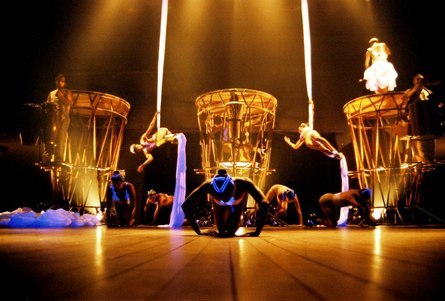
Chicago Human Rhythm Project - Vata Tap

